Wiki · Community post
Alipay vs WeChat Pay for US Tourists: Which One Should You Set Up First?
For foreign travelers in mainland China who can only pick one app, Alipay is the clear winner over WeChat Pay. Both have near-universal merchant coverage and similar foreign-card fee rules, but Alipay pairs directly with AMAP for English navigation, ride-hailing and automatic bil
Verified and updated: September 2026
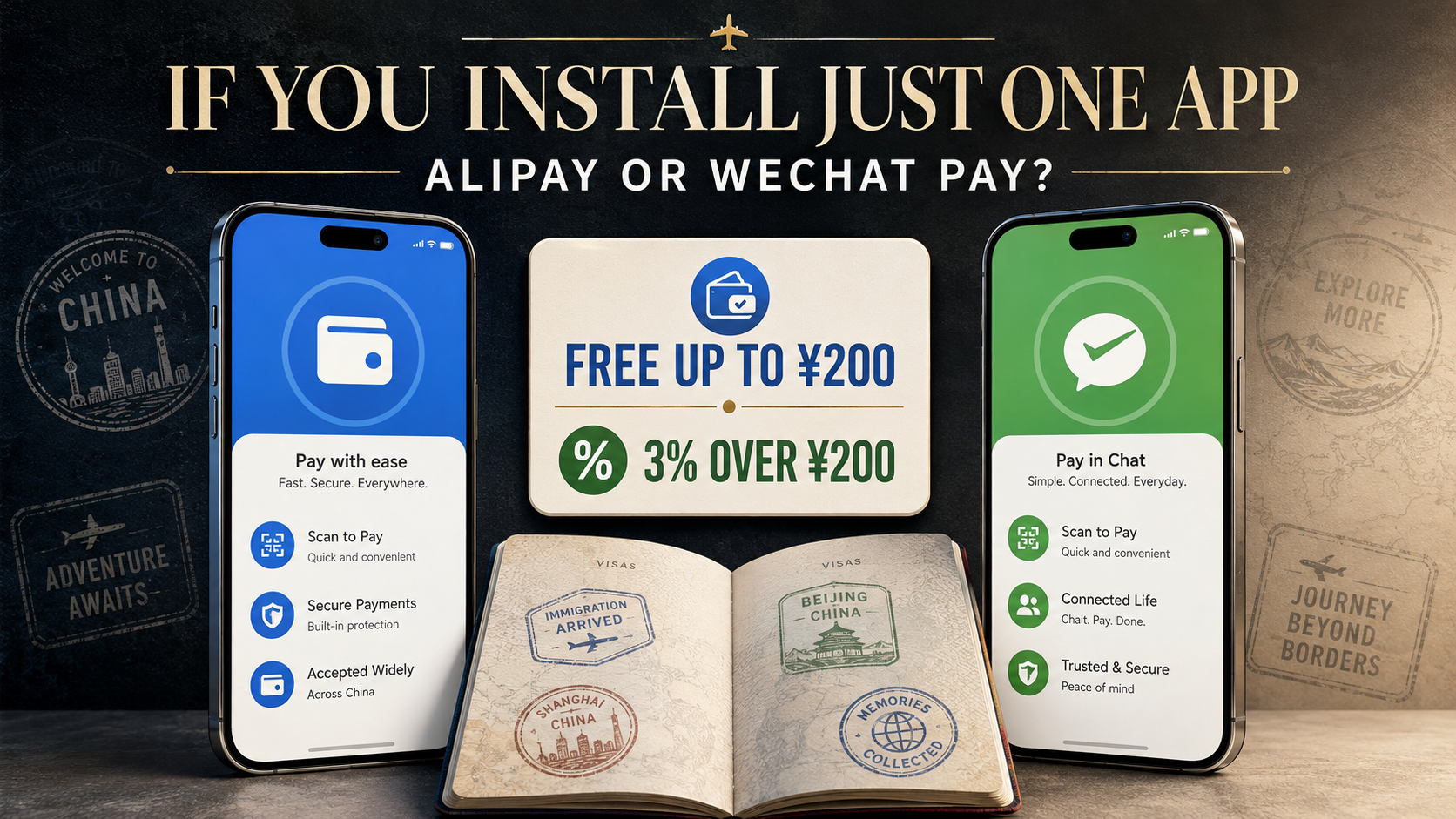
If you're visiting mainland China for the first time, the apps on your phone can make or break your trip. Both Alipay and WeChat Pay now let you link foreign Visa and Mastercard credit cards—what people in the industry call “linking foreign cards for domestic pay.” That means you can scan QR codes and pay for things right away without having to open a local Chinese bank account. Most travel guides tell you to download both apps, but if storage is tight and you can only pick one, most hands-on guides recommend going with Alipay.
Merchant acceptance: essentially a tie
When it comes to paying at actual stores, Alipay and WeChat Pay are neck and neck. Pretty much every shop, restaurant, convenience store, and street vendor across China displays QR codes for both. If a seller takes one, they almost certainly take the other. In theory, you could get by on almost any daily purchase with just one app installed. University surveys on foreign visitors show that mobile payments are widely used while traveling in China, and both platforms handle basic day-to-day spending—like shopping, eating out, or grabbing subway tickets—just fine. Looking purely at payment acceptance, there's barely any difference between them.
Foreign-card fees and limits
Their fee rules for international cards are also broadly similar. For linked overseas Visa or Mastercard cards, transactions of 200 RMB or less are generally fee-free. If a single purchase goes over 200 RMB, the platform may charge a 3% fee on the entire amount; if you receive a refund, that fee is normally returned proportionally too. For example, on a 250 RMB purchase, 3% of the full 250 RMB is 7.5 RMB—not just 3% of the 50 RMB above the threshold. Your home bank may also charge its own foreign-transaction fee, so check your card terms. Published per-transaction limits can differ: WeChat Pay has listed a 6,000 RMB cap for a foreign-card transaction, while Alipay has listed 3,000 RMB. Terms and limits can change, so confirm them in the app before a large purchase.
Why Alipay is easier for travel services
Beyond paying for things, both apps double as Swiss Army knives for daily life. Without downloading separate apps, you can use built-in mini-programs to hail rides on Didi, order food delivery, or unlock shared bikes. But there's a fundamental difference here: WeChat is, at its core, a messaging app that added payments and lifestyle services later on. Alipay was built around shopping, travel, and local services, and its international-facing flow is usually easier for first-time visitors.
Alipay and AMAP: the practical advantage
Where Alipay really pulls ahead is its navigation and transit ecosystem. Most travelers rely on Google Maps back home, but in mainland China it can have GPS-offset issues and stale local detail. The go-to local map app is Gaode Maps, branded internationally as AMAP, and it belongs to Alibaba's ecosystem.
AMAP offers an English interface and supports registration with many overseas phone numbers. You can use it for walking directions, subway and bus routes, hailing rides across hundreds of cities, and hotel booking. Because AMAP and Alipay are closely integrated, a ride or hotel booked through AMAP can charge the linked Alipay account without repeated app switching. That shared account and payment flow is useful for visitors managing navigation and payments at the same time.
WeChat instead relies on third-party mini-programs for maps and ride-hailing. Payments inside those programs can create extra permission prompts or redirects for foreign-card accounts. Travelers sometimes report unavailable features or errors with overseas accounts. The fee rates may be similar, but WeChat does not offer the same tightly integrated navigation-and-transit setup aimed at international users.
When WeChat still matters
Both apps have strong suits. WeChat's biggest advantage is communication: if you need to message local contacts, tour guides, or a hotel host, it is close to essential. You might also encounter the occasional small vendor who only takes WeChat.
Bottom line
If you only have room for one app on your phone, start with Alipay. It gives you broad payment coverage while connecting directly to one of China's most useful local navigation systems, helping with the two biggest headaches for foreign travelers: spending money and finding your way around. If you have space, download WeChat too as a backup for messaging and payments.
Sources and verification
Before travel, verify live terms in Alipay's international-card documentation, WeChat Pay / Tenpay guidance, and AMAP service updates. This guide also draws on Xinhua inbound-travel reports, Trip.com foreign-visitor app guides, and published surveys of foreign visitor mobile-payment use.