
Wiki · Community post
How to Hike Tiger Leaping Gorge: Transport, Luggage Transfers, and Routes
 紧风Shared Aug 22, 2026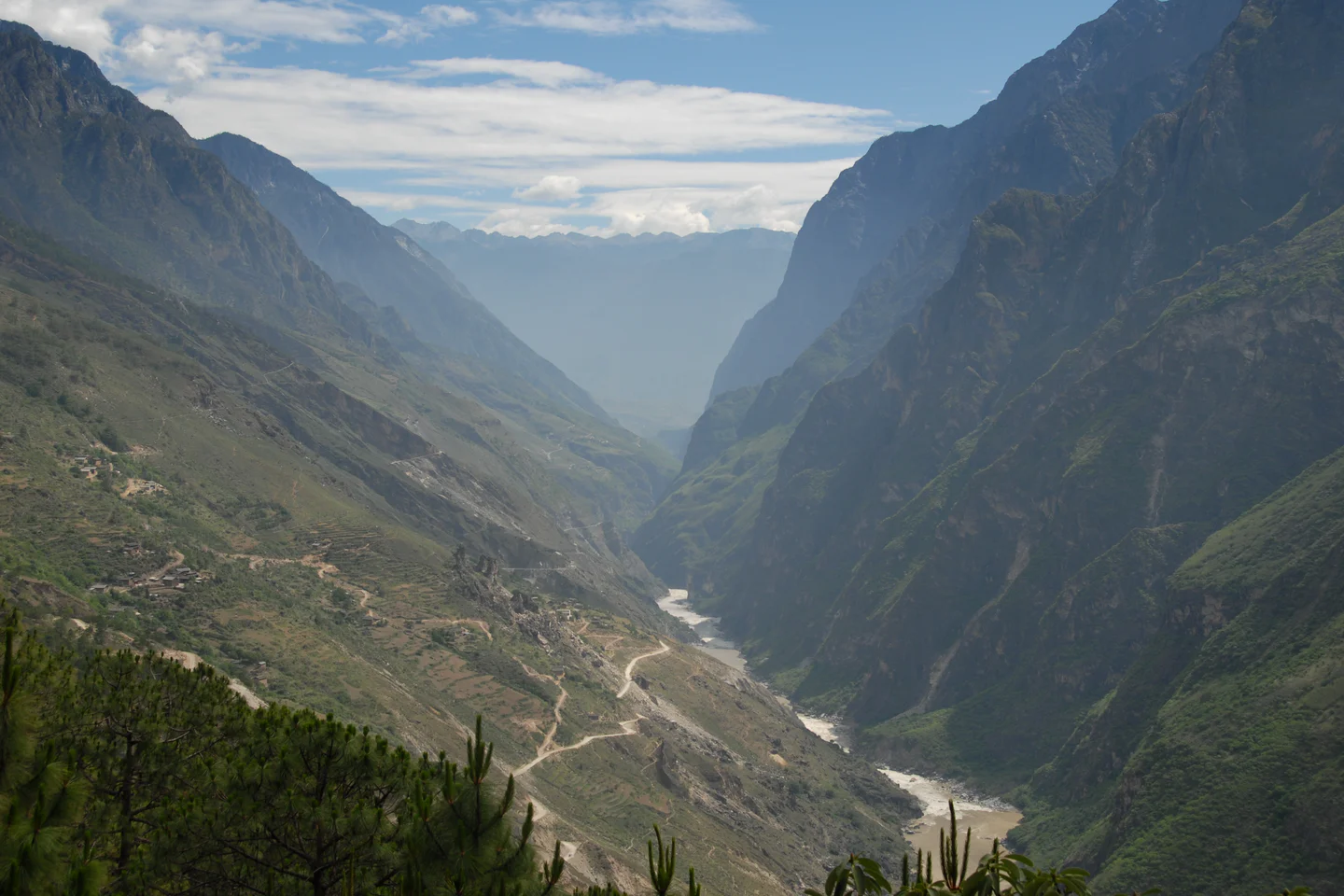
Tiger Leaping Gorge remains one of Yunnan's most rewarding multi-day hikes for foreign visitors, where steep canyon walls tower above the roaring Jinsha River. Most overseas travellers come for the famous High Trail: a moderate trek mixing mountain views, local Naxi villages and quiet paths far from crowded tourist boardwalks. Conditions shift every few seasons, so this 2026 guide covers transport, luggage transfers and which trail layout suits your fitness level.
Getting to the trailhead
Almost all hikers start from Qiaotou, also called Tiger Leaping Gorge Town, roughly two hours from Lijiang. You have three practical ways to get there.
Public bus
Buses leave Lijiang Main Bus Station several times each morning, generally between 8:30 AM and 9:30 AM, and cost about 35-45 CNY per person. The ride takes around two hours. They drop you in central Qiaotou rather than at the hiking path. From there, take a shared local minivan for roughly 20-30 CNY to Naxi Family Guesthouse, the usual High Trail starting point. Do not walk that highway stretch: it is busy and has no safe shoulder.
Train plus local car
Trains run from Lijiang to Tiger Leaping Gorge railway station in about 40 minutes. There is no free connecting shuttle, so you still need a local car or shared van onward to Qiaotou and the trailhead. It saves time on the main leg, but not the local transport hassle.
Shared private van
Shared private vans arranged through a Lijiang guesthouse are the least stressful option for international hikers. Drivers collect you from old-town accommodation, take you to Naxi Family Guesthouse and can forward luggage on the same trip. Expect around 60-80 CNY one way per seat.
Entry tickets cost about 45 CNY from the Shangri-La side. Foreign visitors can book through international platforms such as Trip.com using passport details; domestic Chinese booking apps can require local ID. Carry your physical passport. Real-name booking is enforced, and arriving without a ticket may mean a long wait.
Luggage transfer system
This is the most useful service for foreign hikers. There is no good reason to carry a suitcase or full-size backpack up steep mountain paths. The High Trail includes demanding climbs such as the 28 Bends, and heavy bags turn a pleasant hike into misery.
Luggage forwarding is usually 20-30 CNY per bag. Give your main suitcase or large travel bag to your bus or van driver before you start walking. It can be driven along the main road to Tina's Guesthouse or Zhang Laoshi Guesthouse near the trail end. Carry only a light 20-litre daypack with overnight clothes, a rain shell, water, snacks, sun protection and basic toiletries.
You can also store luggage near the Qiaotou ticket office for roughly 10 CNY per item, then collect it before returning to Lijiang or Shangri-La. Confirm the current drop-off point on the day because local arrangements change. Keep high-value electronics in your daypack rather than a forwarded bag.
Main hiking routes
Classic High Trail: two days, about 22 km
This is the route most overseas visitors choose. Day one begins at Naxi Family Guesthouse and immediately climbs the 28 Bends, a series of steep switchbacks and the hardest part of the trek. Go slowly, take water breaks and do not rush. Once up, the trail levels out past Tea Horse Guesthouse to Halfway Guesthouse, where most people spend the night. Halfway has mountain views, hot showers and simple, filling local meals.
Day two follows the upper canyon rim through small farming hamlets before descending toward Tina's Guesthouse and the main highway. Elevation changes are gentler, but stone and dirt ground can be uneven, so wear non-slip shoes. Plan five to six walking hours. Start before 9 AM both days: afternoon thunderstorms can arrive quickly, and an early finish is safer.
Shortened High Trail: one-day light version
If you do not want to tackle the 28 Bends, arrange a drop-off at Tea Horse Guesthouse. You can skip the big climb, walk to Halfway and continue to Tina's. It is about 10 km and suits casual walkers with average fitness while still offering the signature gorge and snow-mountain views.
Low-road tourist path
The Low Road sits close to river level and is mostly paved boardwalk. It is easy, but often packed with domestic tour groups. It works for a quick sightseeing stop, yet it does not replace the quieter high-elevation scenery of the High Trail.
Safety note: The Sky Ladder descent toward the river at Middle Tiger Leaping Gorge can be restricted because of rock-fall risk. Do not seek unofficial, unmarked side routes; use maintained trails and check local conditions before setting out.
Getting back after hiking
After finishing at Tina's Guesthouse, return transport runs daily. Shared buses generally leave around 3:30 PM for Lijiang or onward to Shangri-La and cost about 40-55 CNY per person. Ask Tina's front desk to book as soon as you arrive, especially in peak months. Shared private vans are another option for small groups wanting more flexible timing.
Quick practical tips for 2026
- Weather changes sharply on the gorge rim. Bring windproof layers even in warm months.
- Rainy season is usually June through August. Rock-fall risk rises, so check conditions and avoid multi-day hiking during severe weather.
- March-May and September-November are usually the best hiking windows.
- Download offline maps in advance. Google Maps does not show every High Trail segment clearly.
- Carry a small amount of cash. Some mountain guesthouses do not accept foreign bank cards.
- Inns sell water, noodles and simple local dishes, but prices are higher than in town, so pack snacks.
Photo: Jo Schmaltz, “Hiking the Tiger Leaping Gorge,” Wikimedia Commons, CC BY-SA 2.0. Source: commons.wikimedia.org/wiki/File:Hiking_the_Tiger_Leaping_Gorge.jpg
Last Updated: August 2026